Access surgeon
Creates the operative corridor and mobilizes the anatomy that lies in front of the spine.

Spinal access surgery · Dallas–Fort Worth
Gerson O. Pineda, MD, FACS is a general surgeon dedicated to anterior and lateral spinal access. He creates and protects the surgical corridor so your spine surgeon can concentrate on the reconstruction.
 Illustrative image
Focused experience
Spinal access is not an occasional part of Dr. Pineda’s practice. It is the center of it. Repetition across routine, multilevel, artificial-disc, and revision operations builds familiarity with the anatomy and the variations that can make exposure difficult.
Practice-reported lifetime experience through September 30, 2026. Case volume does not guarantee a particular result.

Understanding your imaging
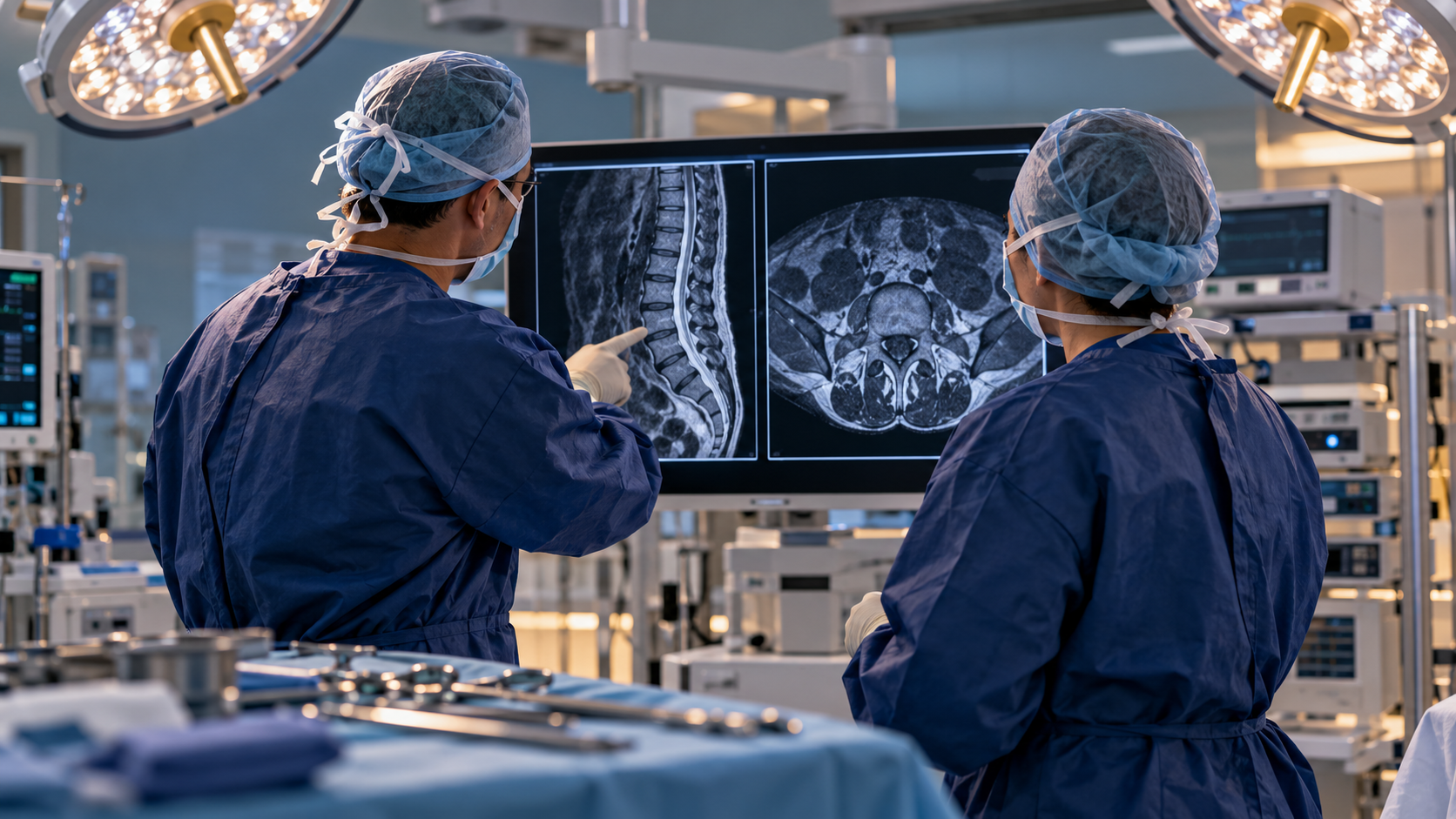
MRI shows the discs, nerves, spinal canal, and many soft tissues. Your spine surgeon uses it with X-rays, CT scans, symptoms, examination findings, and prior treatment history to decide whether surgery is appropriate.
Disc condition Loss of disc height, degeneration, herniation, or collapse may be visible between adjacent vertebrae.
Nerve space MRI may show narrowing around the spinal canal or the openings where nerves leave the spine.
Surgical planning The spinal problem and the safe approach are separate questions. Vascular anatomy and prior operations may require additional imaging or review.
An MRI finding alone does not determine whether you need ALIF. Your symptoms and the complete clinical picture matter.
An access surgeon is a general or vascular surgeon who works alongside your spine surgeon when the spine is approached through the abdomen, side, chest, or another route outside the back.
The access surgeon manages the tissues and structures between the skin and the spine—including blood vessels, abdominal contents, the ureter, and surrounding anatomy—while the spine surgeon performs the spinal procedure.
Creates the operative corridor and mobilizes the anatomy that lies in front of the spine.
Treats the spinal condition through the corridor created for the operation.
Both surgeons remain responsible for their areas of expertise through completion of the case.
Why the role matters
“The surgical corridor remains active throughout the operation. The structures moved to reach the spine must be managed and protected until the reconstruction is complete.”
Gerson O. Pineda, MD, FACS
The abdominal, vascular, and retroperitoneal anatomy requires a different surgical skill set from the spinal reconstruction.
Major blood vessels and surrounding structures may remain mobilized beside the operative field while instruments and implants are used.
Each surgeon concentrates on a defined part of the operation while communicating throughout the case.
Your surgical journey
The exact plan depends on your procedure, health history, and the approach selected by your spine surgeon.
Your surgical team reviews the planned spinal level, previous operations, medical history, and any imaging needed for the approach. Follow the specific instructions you receive regarding medications, eating, drinking, and arrival time.
The access surgeon establishes the route to the spine and protects the surrounding structures. The spine surgeon then completes the planned reconstruction while the access surgeon continues to manage the operative corridor and closes the approach.
Your team monitors your incision, abdominal function, circulation, pain control, and mobility. Recovery instructions vary, so follow the plan provided by your surgeons and contact them for new or worsening symptoms.
Approaches we support
The access plan is selected by your spine surgeon and tailored to the operative level, anatomy, and goals of treatment.
Access to the lumbar disc space through an abdominal or retroperitoneal approach.
Learn about ALIF exposureAnterior exposure for removal of the diseased disc and placement of a motion-preserving implant.
An oblique corridor to selected lumbar levels through the retroperitoneal space.
Access for selected revision operations, including prior implant assessment or removal.
Specialized exposure for selected operations involving the chest or thoracolumbar junction.
Lateral access support when the planned operation requires management of surrounding anatomy.
Anterior lumbar interbody fusion
Develops the retroperitoneal corridor, identifies and moves the abdominal contents and ureter, mobilizes the vessels over the spine, protects them during reconstruction, and closes the approach.
Removes the damaged disc, prepares the spinal level, places the implant and bone graft, and adds fixation when needed.
Lumbar artificial disc replacement
Creates and maintains a precise anterior corridor, manages the vessels during trialing and implant passage, and restores the mobilized anatomy after placement.
Removes the disc, prepares the endplates, selects the implant, and positions the artificial disc to restore motion and alignment.
Oblique and lateral lumbar fusion
Assists with the route through the abdominal wall and retroperitoneum when requested, protecting the peritoneal contents, ureter, vessels, and surrounding structures.
Uses the selected lateral corridor to remove the disc, restore disc height, place the interbody device, and complete stabilization.
Revision anterior exposure
Identifies scarred or altered anatomy, develops a safe corridor, separates vulnerable structures from the prior operative field, and manages the exposure during implant removal or revision.
Evaluates and removes or revises the prior construct, treats the spinal problem, and performs the planned reconstruction.
Candid patient education
Anterior and lateral spine surgery can provide important advantages, but it remains major surgery. Your personal risk depends on the procedure, levels treated, prior operations, anatomy, and overall health.
Bleeding or vascular injury, blood clot, ileus, injury to the bowel or ureter, wound infection, incisional hernia, fluid or lymphatic leak, nerve injury, and—after some lower lumbar approaches—retrograde ejaculation in men.
Nerve injury, persistent symptoms, nonunion, implant migration or failure, subsidence, adjacent-level problems, and the possibility of further surgery. Your spine surgeon should explain how these apply to your reconstruction.
Focused experience supports planning around anatomic variation, efficient exposure, recognition of problems, and immediate management when a complication occurs. It reduces uncertainty; it cannot eliminate risk.
This is a general overview rather than a complete consent discussion. Your surgeons will review the risks that apply to your specific operation.
For spine surgeons
Dr. Pineda works with orthopedic spine surgeons and neurosurgeons across Dallas–Fort Worth. The service is designed around reliable coverage, efficient exposure, continuous management of the access anatomy, and direct surgeon-to-surgeon communication.
Review of levels, prior abdominal or anterior spine operations, vascular anatomy, implants, and factors that may change the exposure strategy.
The access surgeon establishes the exposure and continues managing the vessels, ureter, viscera, and retroperitoneal structures during reconstruction.
A high-volume practice brings repeated experience with L4-5 vascular mobilization, multilevel exposures, ADR, revision surgery, and intraoperative vascular concerns.
Approach-related questions and complications can be evaluated with clear responsibility and communication between both surgeons.
What the evidence supports
Anterior lumbar exposure requires careful work around major vessels, the ureter, and abdominal structures. Dr. Pineda’s practice is dedicated to this phase of care: planning the approach, establishing the corridor, and managing the access anatomy during reconstruction.
Published research provides a supporting rationale. Two systematic reviews found an association between access-surgeon participation and fewer reoperations. Large experienced-team series document exposure outcomes, and an ALIF learning-curve study shows how results can change as experience with the approach accumulates.
Why choose Dr. Pineda
Dr. Pineda combines a dedicated spinal-access practice with 3,728 reported access operations and 6,300+ spinal levels exposed. His experience includes multilevel reconstruction, artificial disc replacement, and revision access, with 50+ surgeons trained.
Two systematic reviews have linked access-surgeon participation with lower reoperation rates. In the 2017 review of 8,028 patients, pooled rates were 1.31% with an access surgeon versus 2.28% without. An updated review of 8,066 patients also found lower odds of reoperation. Other complication findings were mixed.
Review the updated meta-analysisA series of 1,178 patients undergoing 2,352 ALIF levels with vascular access support reported a 4.8% exposure-related complication rate, 1.4% vascular injury, and median estimated blood loss of 25 mL. The study provides a substantial benchmark for the experienced-team approach.
Review the patient seriesAn ALIF learning-curve study followed 127 patients whose exposures were performed by the same vascular access surgeon. Blood loss and vascular issues requiring repair or packing declined with accumulating experience. The authors identified a learning curve of approximately 25–30 cases, reinforcing the importance of experience with the approach.
Review the learning-curve studyDr. Pineda’s experience figures are practice-reported through September 30, 2026. Research results describe the study populations and do not establish his individual complication rates or prove superiority over other experienced surgeons.
Access coverage
For case coordination and scheduling in the Dallas–Fort Worth area, contact the practice team. Have the planned procedure, spinal levels, facility, and preferred date available.
Call 214-269-5353 Spinal access coverage detailsSurgeon education
Visiting spine surgeons may request a focused educational experience with Dr. Pineda. The program is built for surgeons who want to better understand anterior exposure, case selection, vascular mobilization, revision strategy, complication avoidance, and collaboration with an access surgeon.
Participation depends on hospital approval, credentials, case availability, and patient consent. Observation does not grant operative privileges.
Ask about a visiting-surgeon experiencePhysician leadership
Dr. Pineda is a board-certified general surgeon whose practice is dedicated to anterior and lateral spinal access. He works collaboratively with spine surgeons throughout the Dallas–Fort Worth area, focusing on safe exposure, protection of the structures surrounding the spine, and coordinated care throughout the operation.
Dallas Baptist UniversityBachelor of Science in Biology with an emphasis in Biochemistry
University of Texas Health Science Center at San AntonioDoctor of Medicine
University of Arizona, PhoenixGeneral Surgery Residency
Dallas Surgical Specialists — Dallas, TexasFocused, mentored postgraduate training in spinal access surgery, including 175 supervised spinal access cases before independent practice.
Patient questions
Your own surgeons’ instructions take priority because every procedure and patient is different.
Your spine surgeon may request an access surgeon when the route to the spine passes near major blood vessels, abdominal organs, the ureter, or other structures requiring separate surgical expertise.
The access surgeon’s role commonly continues beyond the initial exposure. The surgeon may maintain or adjust the corridor, protect surrounding structures, monitor the mobilized vessels, and complete the closure.
No. The surgical team determines whether separate access-surgeon participation is appropriate based on the planned procedure, anatomy, health history, facility, and surgeon judgment.
Discuss your individual risks with both members of your surgical team. Your spine surgeon addresses the spinal procedure, while the access surgeon can explain risks related to the surgical approach.
Your spine surgeon’s office generally coordinates the access surgeon as part of the surgical plan. Ask your surgical coordinator if you are unsure who will be involved.
A clear role in complex care
If an access surgeon is part of your planned operation, your spine surgeon’s office will coordinate the team and provide the contact information you need.
Review patient questions